Search This Blog

Showing posts with label Dark line w/Ivory. Show all posts

October 5, 2020

Test Results :: Dark Emerald


Effetre Dark Emerald is a vibrant, pure medium green transparent. It is relatively inert with other colours -- even with Ivory it has only a very slight brown line reaction. I was expecting it to be more reactive than it is, so I was pleasantly surprised.


Here, you can see that reducing Dark Emerald makes no appreciable difference in itsappearance.


Dark Emerald does nothing with silver until you reduce and encase the silver - then you get faint bluish hints here and there that remind me of how silver interacts with the cobalt blues.


Dark Emerald seems to make a nice base for both reducing and striking silver glass.


And finally, here you can see how very non-reactive this colour is. You'll notice there's a weird, dark sooty line between the Ivory and Peace, but I think that is nothing to do with Dark Emerald and quite a lot to do with me needing to clean my torch head. Also, there was a batch of Peace that did this fairly easily a few years back, and it's possible that I still have a few rods of it mixed in with my newer stock.

And here are some fun beads with Dark Emerald.  On the whole, I think this colour is a bit brighter than I really like to work with. If I am going to use the rest of my stock, I think I will probably mix it with other transparent colours to see what I can do with it in blends.


August 6, 2020

Test Results :: Light Gray


Effetre Light Gray (EFF248) is an elephantine opaque colour. It is somewhat reactive with Ivory, fairly inert with other colours, and makes an interesting base colour for silver and silver glass.


When you reduce it, Light Grey 'browns up' a little.


Silver on top of Light Grey turns yellowish and pinkish. When the silver is reduced and encased, it loses this interesting colour.


Reducing silver glass spreads and develops a nice sheen on top of Light Gray. I got a decent starting strike from my TerraNova2 on top of this colour, and like the pale halos that I can see around the TerraNova2 fritty bits.


Light Gray separates a little on top of Tuxedo.

Ivory and Light Gray develop a reciprocal dark line reaction. In the case where the Ivory is on top, the result is a dark line that almost looks like a shadow. When the Light Gray is on top, the reaction is crackly and intermittent, giving the stringer lines and dots a translucent, jagged appearance.

Here are some other beads that include Light Gray:


May 7, 2020

Test Results :: Troi


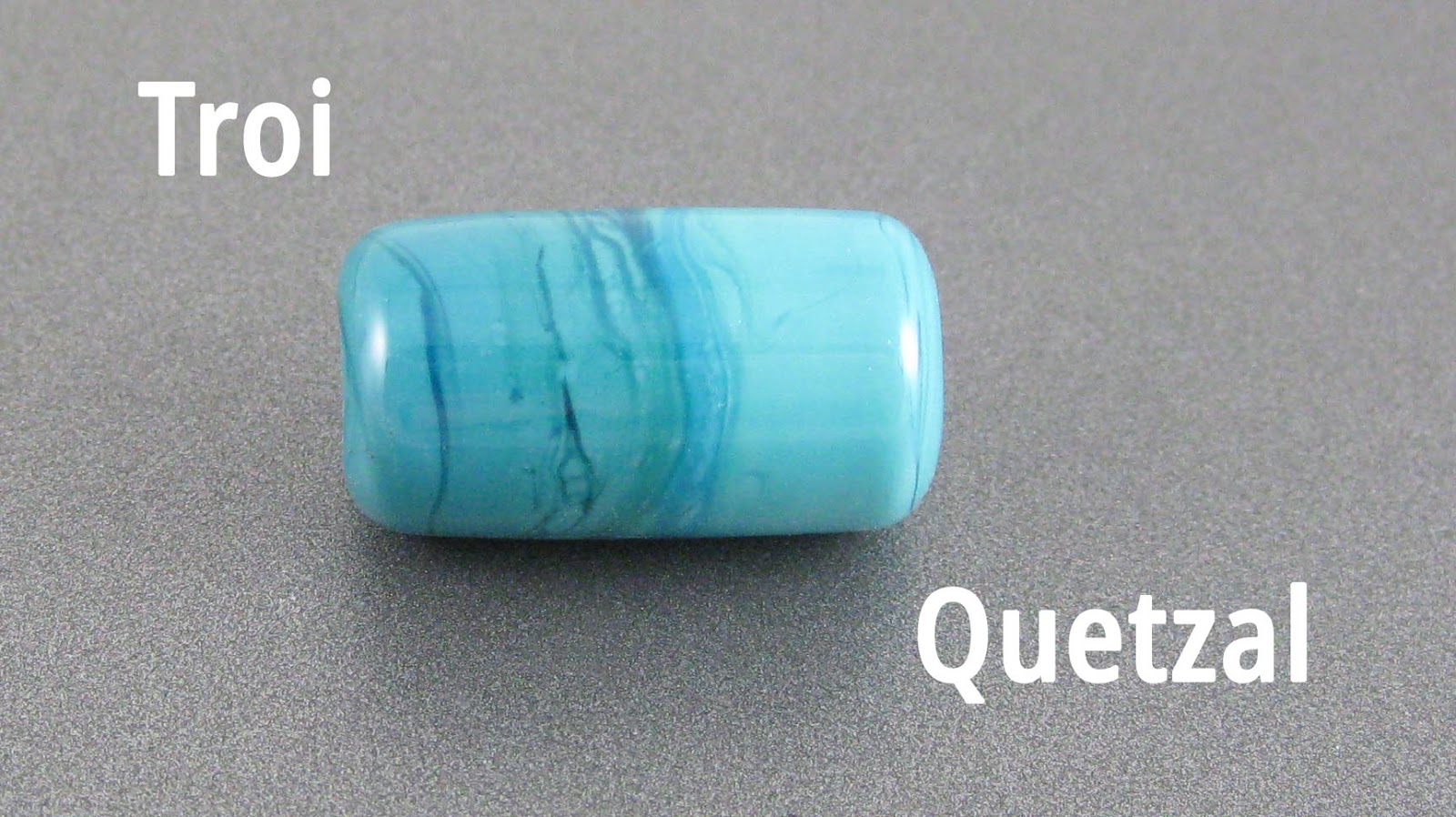
CiM Troi (CiM558) is a vibrant medium teal opaque. It reminds me of Mermaid, only a bit lighter and bluer.

I was a little unprepared for how vibrant it would be, because the rod colour is a little more subdued than this colour ends up being after working and annealing it. It's quite a streaky colour, leaving little trails and veins of darker teal all through it no matter how carefully you work.


Like many other colours in the turquoise/teal families, you can get a brick red reduction on Troi. You sort of have to work at it, though, and the result I got was blotchy. I tried a variety of strengths of reduction flame, and a variety of flame-height positions while reducing this and was not able to achieve an even coverage. Maybe you'll have better luck?


The reason Troi's vibrance surprised me so much is that in rod form, Troi is almost exactly the same colour as Quetzal. However, after working Troi gets darker, and Quetzal must get a bit bluer because they are nothing alike after coming out of the kiln.


Troi reacts predictably with silver. Silver leaf only seems to turn this odd shade of mustard when it is reduced and encased on teal glass. I really like how the silver leaf coalesced in the veins where the Troi separated from itself in the leftmost bead.


My striking silver glass frit in the bead on the right developed some interesting colour.


On top of Troi, Copper Green and Opal Yellow both separate.

Ivory and Troi develop a reciprocal dark line reaction, and the reaction is so strong that it discolours the stringer line's interior as well as its edges. When Troi is on top of Ivory, the brown line creeps into the Ivory in varying amounts.

Troi separates on top of everything because it's so streaky.


Here are some other beads that contain Troi:


March 6, 2020

Test Results :: Skyberry


Effetre Skyberry (EFF768) is a light blue opaque colour that blushes turquoise. It's like what you'd expect to get if Light Sky Blue and Copper Green got together and had a love child.

Like Copper Green, Skyberry develops a greyish sheen on its surface while it's being worked, although Skyberry's sheen tends more to the pinkish side, which is I guess where the whole 'berry' thing comes from. This sheen goes away when it is distracted by other surface reactions, like what you see in my colour tests with Tuxedo and Ivory.

I went to check my findings for Light Sky Blue to see how this colour and that one are similar, only to realize in a surprised and slightly horrified way that I haven't tested that colour yet.


In the bead on the left, you can see what Skyberry will do in a typical, same-coloured spacer. It's darker at the edges, and lighter in the middle, covered across the shoulders with a pale pinkish greyish sheen.

When I reduced Skyberry in the bead on the right, it turned a dark brick red.


Silver makes an interesting greyish-greenish patina on the surface of this colour, which mostly disappears when it is reduced and encased.


Like most blues, this colour is a pretty boring base colour for silver glass.  The reactions in both beads are interesting - you can see the Skyberry doing odd things around the edges of the frit in both cases - but it fails to make the colours pop, and I didn't find it a good base to strike my striking silver glass frit on.


Tuxedo separates Skyberry both when it is used on top of and underneath it, and Skyberry develops a dark line with Ivory in exactly the way you'd expect it to, as a close cousin of Copper Green.  Skyberry also separates on top of Copper Green which I thought was interesting.

In the bead on the left, if you look closely, you may notice that I accidentally used Opal Yellow twice instead of testing with Peace the way I meant to.  Oops.

Anyway, here are some fun beads with Skyberry. I still have about a half pound of this left, and plan to use it all before I move on to another palette. I am glad that Frantz still has more of this, as I'll want to put some aside for the next time I feel like working with a light blue.


June 28, 2019

Test Results :: Porpoise


Porpoise (CiM828) is a medium grey opaque. When it is molten, it is disconcertingly green in colour. I thought for sure that the finished beads would be greenish, but they aren't in the least.


Reducing Porpoise turns it brown.


Porpoise seems to fall somewhere between Effetre Light Gray and Effetre Dark Gray in hue. It's much darker than Pearl Grey, and less blue/green than Bayou, another new CiM colour.


On top of Porpoise, reduced silver turns yellow under encasement.


Porpoise gets an interesting light border around TerraNova2 frit, and the colours really popped in my reduction frit bead. It seems like it might be an interesting base colour for silver glass.


Porpoise separates on top of Tuxedo, Copper Green, and Peace. It spreads out on top of Opal Yellow, and develops a brownish dark line reaction with Ivory.

On top of Porpose, Copper Green separates and Ivory develops a dark shadow line around its edges that looks like it has texture.

These beads contain some Porpoise.


June 20, 2019

Test Results :: Cerulean


CiM Cerulean (CiM559) is a medium aqua transparent, almost the same colour as Effetre Light Aqua. It's maybe a shade or two darker than Light Aqua and a little stiffer in its working viscosity.  For me, this colour and Cerulean Sparkle (CiM560) were essentially the same colour so I'm not testing them separately.


Here the small spacer only looks a bit darker because there's less glass on the mandrel to colour-filter the dark grey background. I noticed no real visual difference when I reduced this colour.


On top of Cerulean, silver beads up and disperses the same way as it did on top of CiM Aiko, but unlike my results with that colour the silver here turned greyish and looked a little smeared. 

Cerulean doesn't discolour silver, as you can see in the middle bead where I sandwiched a layer of silver foil between a base and encasement layer of Cerulean.

Finally, when I reduced and encased silver leaf on top of Cerulean I got a lovely silvery and blue-blushed coating underneath my Super Clear.


I got some good starting strike out of my TerraNova 2 frit with this colour, and silver glass seems to generally like it although I don't have much use for the blue-on-blueness of the left bead.


I really like the colour I got from Cerulean when I layered it over Opal Yellow. It got bluer and the dots and lines have a slightly mottled look that is very appealing and organic.

When Cerulean is on top of Ivory, it turns the Ivory brownish the same way Effetre light Aqua does. Strangely enough, when the Ivory is on top, you don't see much reaction between the two colours.

Here are some other beads that include Cerulean:

May 28, 2019

Test Results :: Smurfy


Smurfy (CiM569) is a medium to dark turquoise opaque colour. I found it really creamy and nice to work with, and vastly prefer it to the other dark turquoise opaques (Dark Turquoise, Dark Sky Blue) from Effetre because it doesn't easily develop that greyish dirty patina that other turquoises get, although you can make that happen if you really try.


You can see in the bead on the left that when I reduced Smurfy it got a greyish haze on its surface. I reduced this bead a few times trying to get it to change colour. I was hoping for that solid red brick coating you can sometimes get on turquoises, but that doesn't seem to happen with this one.


Smurfy is darker than both Light Turquoise and Fremen, more of a shade with Dark Sky Blue. Unlike Dark Sky Blue, it doesn't easily develop that grey sheen, although you can make it happen if you hold it in a reducing flame.


On top of Smurfy, silver leaf looks a greyish green colour. When you reduce and encase it, it turns yellow.


Smurfy seems like it is probably a decent base for silver glass.


Like other turquoises, Smurfy gets a dark line with Ivory. Smurfy separates on top of Tuxedo and Copper Green. Apart from that, there weren't very many reactions in these beads.

Here are some other beads made with Smurfy.