Search This Blog

Showing posts with label Teals. Show all posts

June 12, 2021

First Look :: Avalon Milky & Avalon Misty

CiM Avalon Milky (CiM4003) and Avalon Misty (CiM4002) are soft, minty, pale green, translucent colours. They melt beautifully, with no bubbles or scumming. These glasses are really only different as regards their opacity, so I feel like it is makes sense to post about them together. In general, I typically prefer the misty colours to the milky ones because I enjoy the brightness of them, and this was true for me with Avalon as well.


You can clearly see here the difference between the milky and misty versions of this colour. They are both beautifully translucent, but the misty beads show just a bit brighter and lighter because more light is passing through them.


Silver Foil under Avalon turns an odd lemon yellow colour.

I decided to try this just because the silver foil turned a bit yellow, but it turns out that lemon yellow is not quite yellow enough to do anything impressive with the frit. These streaky results are pretty, but they are also achievable by using regular colours rather than the expensive silver glass ones, so I'll never do this again.

Here are some fun beads that I made with these colours. I'm not really sure which is which now, but you can rest assured that whichever of these colours you choose to buy, you're getting something pretty neat. The butterfly murrini were created by the lovely and talented Jackie Gundelfinger.


May 7, 2020

Test Results :: Troi


CiM Troi (CiM558) is a vibrant medium teal opaque. It reminds me of Mermaid, only a bit lighter and bluer.

I was a little unprepared for how vibrant it would be, because the rod colour is a little more subdued than this colour ends up being after working and annealing it. It's quite a streaky colour, leaving little trails and veins of darker teal all through it no matter how carefully you work.


Like many other colours in the turquoise/teal families, you can get a brick red reduction on Troi. You sort of have to work at it, though, and the result I got was blotchy. I tried a variety of strengths of reduction flame, and a variety of flame-height positions while reducing this and was not able to achieve an even coverage. Maybe you'll have better luck?


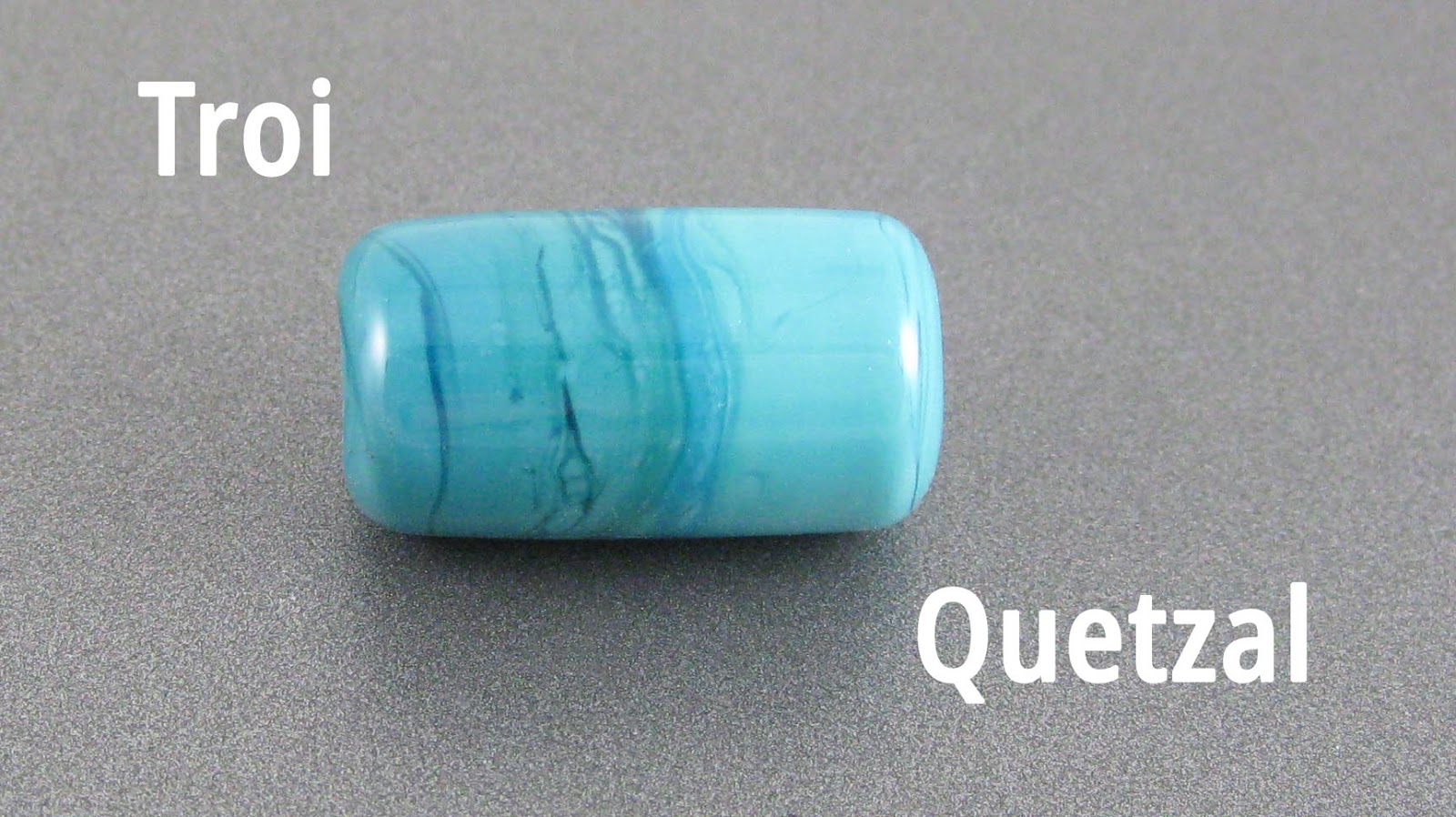
The reason Troi's vibrance surprised me so much is that in rod form, Troi is almost exactly the same colour as Quetzal. However, after working Troi gets darker, and Quetzal must get a bit bluer because they are nothing alike after coming out of the kiln.


Troi reacts predictably with silver. Silver leaf only seems to turn this odd shade of mustard when it is reduced and encased on teal glass. I really like how the silver leaf coalesced in the veins where the Troi separated from itself in the leftmost bead.


My striking silver glass frit in the bead on the right developed some interesting colour.


On top of Troi, Copper Green and Opal Yellow both separate.

Ivory and Troi develop a reciprocal dark line reaction, and the reaction is so strong that it discolours the stringer line's interior as well as its edges. When Troi is on top of Ivory, the brown line creeps into the Ivory in varying amounts.

Troi separates on top of everything because it's so streaky.


Here are some other beads that contain Troi:


April 8, 2019

Test Results :: Aiko


CiM Aiko (CiM468) is a light teal transparent colour, very similar in hue to Effetre Light Teal. It's a bit stiffer than Light Teal, and I found it easier to boil than Light Teal until I got the hang of giving it a bit less heat than my normal.

After doing these tests, I would choose Light Teal Transparent over this colour if I were going to be encasing with it, but if I was planning to use it with Silver or with other colours in combinations where I wanted to minimize any angry reactions, then I would definitely go with Aiko instead.


Here you can see that as I eased into these test beads, I didn't have a great feel for how hot I could get Aiko without it bubbling. This is not a particularly difficult colour to use, and it's easy to avoid these bubbles if you work up a bit higher in your flame.

Reducing Aiko doesn't change its colour at all.


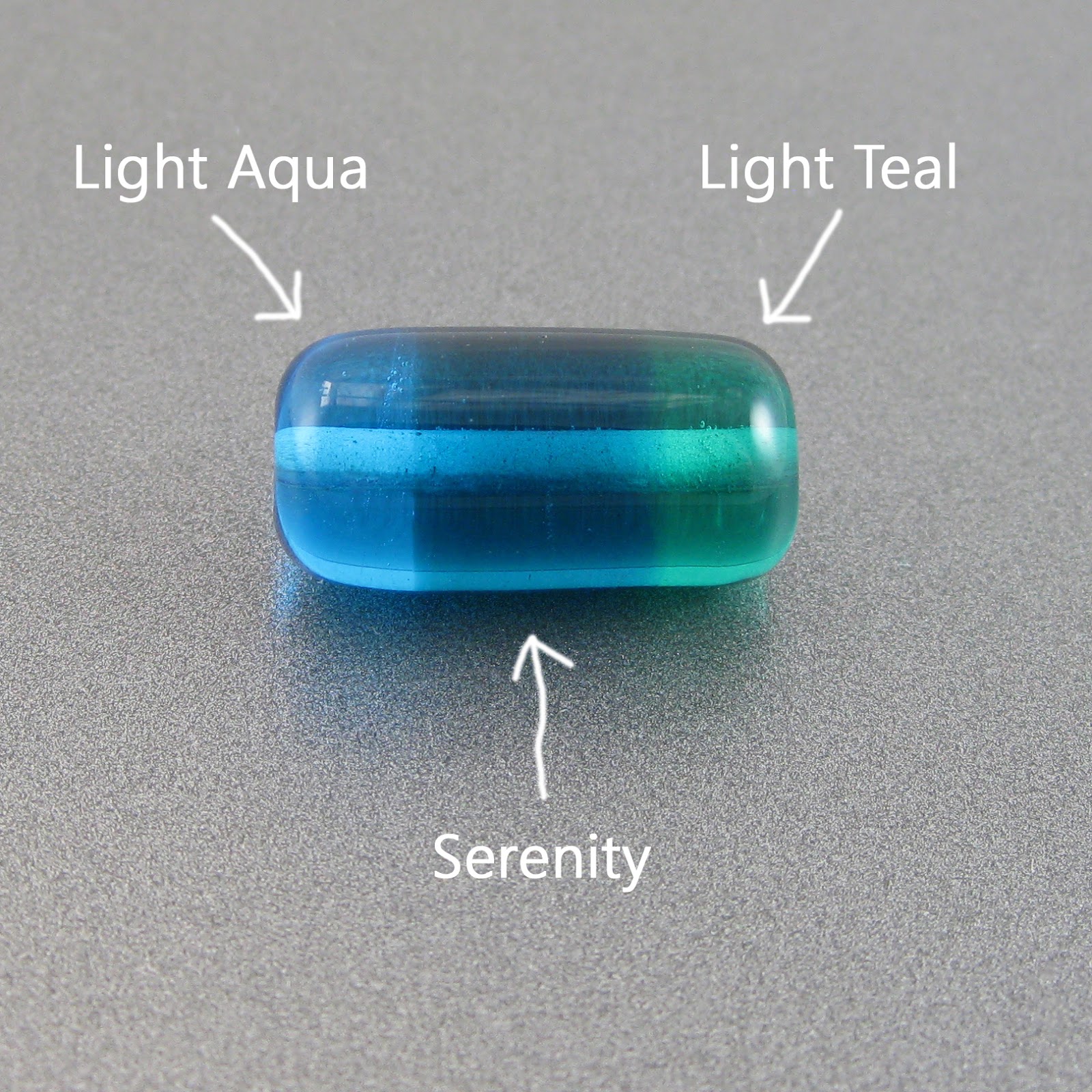
Here I've sandwiched Aiko between Serenity and Light Teal. You can see that it is only very slightly darker than Effetre Light Teal and a bit lighter and quite a bit greener than Serenity.


Silver beads up and disperses over the surface of Aiko. When you reduce and encase the silver, it is a greyish blue. This is quite different from the result I got when I encased silver under Light Teal, because in that combination the silver turned quite yellow.  I wonder what the difference is chemically?


Silver Glass is pretty nice on top of Aiko, both the reducing kind and the striking kind.


There are no significant reactions in these test beads apart from a very minor amount of dark line reaction when Aiko is on top of Ivory. There's maybe a tiny bit of separation in Peace, Copper Green, and Ivory when used on top of it, but it's very, very minor.

I am always excited when I find teals, turquoises, blues, and greens that are not very reactive because they are more versatile than their more volatile cousins. This colour is like a paler and greener version of Serenity, with fewer and less dramatic separation reactions with other colours.

Here are some other beads made with Aiko.


March 5, 2019

Test Results :: Petroleum Green


Effetre Petroleum Green (EFF218) is a pretty teal green opaque colour. I had never really used it before I made these beads and some things about it really surprised me.

The things that I found surprising about this colour will maybe not come as surprises to you. For one thing, this colour is very, very streaky. You can see streaks in it when you make simple spacers, and it separates like mad on top of just about everything. It's also very soft -- much softer than using other opaque teals like CiM Mermaid and Effetre Marine Green will prepare you to expect.


I expected Petroleum Green to turn red when I reduced it, but it didn't.


Silver isn't very interesting on top of Petroleum Green until you reduce and encase it and it turns a bright mustard colour. Petroleum Green has this yellow-with-silver-under-clear thing in common with Copper Green, Light Teal, Light Aqua, and Celadon.

Unfortunately, encasing the reduced silver will crack your bead. If you've made beads before with Petroleum Green and silver and then encased your beads with Effetre Super Clear only to find they cracked... well... me too.


Silver Glass is interesting on top of Petroleum Green. Because the Petroleum Green is so very soft, it rises up and swallows frit pretty easily, which is why you might be wondering why I didn't put more frit on the leftmost bead. It is a decent base for striking silver glass colours - my TerraNova2 frit got a very nice starting strike.


As I mentioned already, Petroleum Green separates on top of everyhing. It also gets a creeping brown reaction line with Ivory that is not very uniform.

Opal Yellow and Copper Green both separate on top of this colour.

Here are some beads made with Petroleum Green.


November 8, 2018

Test Results :: Cotswold Blue


CiM Cotswold Blue (CiM554) is a medium teal opaque. It's a bit reactive with Ivory, but is otherwise fairly well behaved. My rods of Cotswold Blue were mildly shocky, but I liked it enough anyway to order a full pound of it, so I clearly didn't mind it all that much.


Cotswold Blue doesn't change colour when you reduce it.


Silver leaf on top of Cotswold Blue largely disappears, beading up in tiny little silver granules on the surface. When the silver is reduced an encased, it turns an odd mustardy colour.

The Cotswold Blue bead with silver on it cracked. You can't see the cracking in the photo very well, but it cracked on a diagonal under the clear. More and more, I am realizing that these darker teal blue colours (Petroleum Green, Rainforest, and this one among others) encase just fine until you add silver, but that the addition of silver somehow tips the crack balance. I'm not sure why this is the case, but am glad that I'm finding a pattern that will make this problem easy to avoid.


Cotswold Blue is a very pretty base colour for striking silver glass, and I got nice colours from my TerraNova2 frit on top of it. Its colour isn't really conducive to hosting the reducing silver glass colours since it is so similar, but you can see that there was some interesting spreading behaviour in that frit in the leftmost bead above, too.


Copper Green, Ivory, and Opal Yellow all separate on top of Cotswold Blue. Cotswold Blue is such a streaky colour that it separates on top of everything.

The only real reactions of note here were:

  • Ivory and Cotswold Blue form a mutual dark line reaction
  • The edges where Peace and Cotswold Blue meet get sort of fuzzy and translucent. You can see this in both beads.


Here are some other beads that include Cotswold Blue:


October 4, 2018

Test Results :: Serenity


CiM Serenity (CiM557) is a gorgeous medium teal transparent. It's a beautiful shade of teal blue and really fills a hole in my palette. Although it is a blue-green and does react like one, its reactivity is far gentler than other colours in the same hue range, making it possible to use this colour with Ivory and other sulfur colours without significant discolouration.


I found Serenity nice to work with. It can boil if you let it get too hot, and you can see some small bubbles in one of the spacer beads above, but on the whole, bubbling problems with Serenity are avoidable by working cool. Serenity does not change colour when you reduce it.


Serenity is not as saturated as CiM Great Bluedini but it is around the same shade of teal. It is a great deal bluer than Effetre Light Teal and is both darker and greener than Effetre Light Aqua.


Silver leaf beads up and largely disappears on top of Serenity, and if the silver is reduced and encased, it forms a greyish blanket under the clear layer. These reactions are both consistent with what I experienced with CiM Great Bluedini.


Also similarly to Great Bluedini, Serenity makes a decent base colour for silver glasses. The reduction frits look pretty on top of it, and I got a reasonably good starting strike from my TerraNova2 frit.


First, I apologize for the dirt in this picture. I try to get all of the beads clean, even soaking them in clean water after cleaning the bead release out, but some of it always seems to get by me.

Like other teal colours, Serenity will develop a dark line reaction with Ivory. In Serenity's case, this reaction line is very thin and gentle, which is nice.

Copper Green, Opal Yellow, Ivory, and Peace all separate on top of Serenity.

Serenity's presence seems to inhibit Copper Green from developing that greyish sheen it often likes to develop in the flame.

These beads all contain some Serenity.


December 11, 2017

Test Results :: Poolside


Poolside (CiM553) is a beautiful light teal transparent. Like with other light CiM transparents, I found that this one had a tendency to boil, but that you can avoid that problem by working further up in the flame and being careful not to overheat it. 


Reducing Poolside does not alter its colour. The smaller bead looks darker here only because more of the darker grey background colour shows through less glass.


Poolside, huewise, falls somewhere between Effetre Light Aqua and Effetre Light Teal, with just a smidgen less saturation than either of those colours. It's bluer than Light Teal, but greener than Light Aqua.


On top of Poolside, silver leaf balls up and disperses. If you reduce and encase it, it forms a greyish blanket under the clear layer.


I got nice colour from my TerraNova2 frit on top of Poolside.


The most interesting thing about Poolside is how mildly it reacts with Ivory. Other teals and turquoises form an intense dark line reaction with Ivory, but Poolside developed only a faint brown reaction when used on top of it, and no dark reaction at all when Ivory was on top.

Poolside separates Copper Green, Opal Yellow, Ivory, and Peace.

I don't have anything else to show you with Poolside yet, but if that changes I will come back and update.